Space Dome
With the latest projection technology, using real science data,
we bring the real universe to you. Get closer to the wonders
of the universe while travelling with us through time and space.
An educative, inspiring, fun and exhilarating trip that will stick in
your mind forever!
Space Dome UK
Our Space Dome is designed to explore science, astronomy, geology and geography in an interactive way bringing the power of digital planetariums and LIPS methodology (Live, Interactive Planetarium Shows) to children and communities all around the UK. We provide immersive educational experiences that make learning stick! Either if you are looking for the ‘wow factor’ of a large immersive display environment to entertain large numbers of viewers or want to educate a group in science topics, we are here to help.
Why us? We base our presentations in real scientific data to bring the real universe to our domes. Our projectors can capture real Earth data as well as space data. For example, in our show about Mars we can present the different layers of the planet in a 360 degree view using real scientific data, providing this way a deep study of the planet. We can explore its volcanoes, polar ice caps, canyons and thin clouds obtaining a better understanding of the planet in its three-dimensional structure.
We use the latest projection technology and go beyond simulators to offer an experience that feels real. We focus on quality and learning impact along with showing the wonders of our universe and bringing an exciting experience that the audience will never forget.
Space Programme
Check out our exciting Space Dome Programme below and if you require a specific topic that’s not on the list, just get in touch as we will very likely be able to help.
KS2/3 on 'Solar System Tour and Beyond'.
We’ll dive into:
– The planets
– Small bodies: asteroids, comets, meteoroids and dwarf planets.
KS1/2 on 'Space Exploration' (Apollo Moon Landings).
'KS1/2 on Earth and Beyond'
- The Earth, Moon and Sun.
- Gravity
- Day/Night
- Seasons and Space
- Exploration of the Moon
- And much more!
KS1/2 on 'Light/Dark and Space'
– What is light and its properties.
– Light in space.
– Reflection VS Refraction.
– Opacity, translucency and transparency.
– And much more!
Some of the questions we’ll dive into:
– How the eye works and shows us different colours.
– The rainbow.
– Why do we have daytime and night-time?
– How do we know so much about the stars?
– Why do the stars have different colours and brightness?
KS1/2 on 'Light and Sound'
How your ear drums work to hear sound?
What sound looks like, how your eyes work to capture the light and how images are created?
Deep into light and sound with us in this interactive and immersive session.
Explore and learn how sound and light travel. Get to ‘see’ sound in many different ways. Learn about rainbow and colours; refraction and reflection and much more. We’ll use examples from solar system with the moon and sun in 3D.
KS1/2 on 'Ancient Egypt (or Greece) and the Stars'
KS2/3/4 on 'Dynamic Earth'.
Covering climate, ocean currents, ocean life and the changing world.
An immersive fulldome program that explores the inner workings of Earth’s climate engine. With visualizations based on satellite monitoring data and advanced supercomputer simulations, this cutting-edge production follows a trail of energy that flows from the Sun into the interlocking systems that shape our climate: the atmosphere, oceans, and the biosphere.
Audiences will ride along on swirling ocean and wind currents, dive into the heart of a monster hurricane, come face-to-face with sharks and gigantic whales, and fly into roiling volcanoes. Year 3 to adult age range.
'Introduction to Stargazing': Story telling and the Stars
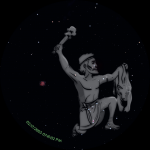
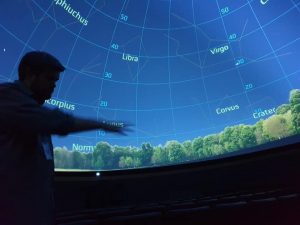
‘Introduction to Stargazing’ uses all the projectors below to give a star field and tour of the night’s sky.
The Science Dome has three star projectors which project a star field on the inner surface of the dome. The purpose is to demonstrate how the sky appears in the night sky and also how to observe various planets and shooting stars.
One star projector is produced using a computer with state of the art Stellarium software. This can also be downloaded and used on a PC desktop. Visit the link below.
http://www.stellarium.org/
The other two projectors use actual film of the real night sky and project a star field accurately with 10,000 stars. The star field moves across the dome also showing shooting stars and the moon.
'Oasis in Space’
'Black Holes-The Other Side of Infinity'.
KS1/2 on 'Environments' on land and the ocean.
KS1/2 on 'Under the Sea', 'Weather','Pirates & the Sea'.
Including elements such as underwater volcanoes, bioluminescence and tides.
Under the Sea:
We learn that many years ago sailing boats used to follow the stars for navigation. We take a journey on a boat and then go under the sea. We’ll listen many stories by sailors about life in the sea, and much more!
Start journey to the bottom of the sea by a submarine and back again. The planetarium shows the Australian landscape and the Australian stars and refers to the southern cross and compass using the constellations. The Great Barrier reef and other under the sea locations are shown.
Pirates and the Sea:
‘Pirates show with many ship wrecks. Pictures of sailing ships, pirates ships and flags from a 360 degree view. Australian stars and the southern cross and compass will be also covered.
We have pictures of caves and rocks which can be used for smuggling.
KS1/2 on 'Mini beasts' or 'Tropical Reefs.'
Minibeast:
We will learn and explore the world of minibeast. Minibeasts are small invertebrates and include arthropods such as spiders, insects, woodlice, centipedes and millipedes, as well as slugs and snails and worms.
Tropical Reefs:
Learn the secrets of the “rainforests of the sea” as you and your visitors embark on an oceanic safari to the world’s most vibrant — and endangered — marine ecosystems.
Learn about the biology of corals, and how reefs support some of the planet’s most complex food webs.
KS1/2 on 'Endangered Animals'.
The natural environment.
What are endangered animals?
Why are some species in danger?
– Habitat Loss (Destruction and Fragmentation)
– Invasive Species
– Pollution
– Poaching
– Overuse
Science: Recognise that the population of some animals/species are in danger of becoming extinct through loss of habitat, decline in food source or persecution for example.
The interdependence of living organisms and food chains.
How humans affect the local environment.
Geography: Causes and consequences of how places and environments change – Living in my world: caring for places and environments and the importance of being a global citizen.
How can we help prevent the extinction of endangered animals?
We will explore the topic of endangered animals in our 360 degrees mobile planetarium and invite children to reflect on the importance of keeping a balanced ecosystem. From tiny species to the biggest creatures, they all contribute to the equilibrium of nature.
Ecosystems are groups of plants and animals that are found in the same area and interact with each other bringing a healthy state to the ecosystems when they act in harmony. Each species that is lost triggers the loss of other species within its ecosystem. Plants, animals and all type of micro-organism bring balance to the ecosystem (forests, grasslands, rivers, oceans…) maintaining it healthy. Preserving wildlife helps not only to the ecosystem but also provides cures to deadly diseases, purifies environment (clean air, water and land). Allowing our environment to become contaminated, we risk our own health.
Healthy forests, grasslands, rivers and oceans are the result of a balanced ecosystem.
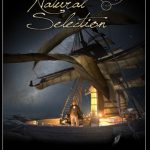
KS2/3/4 on 'Natural Selection'.
Adaptation and evolution.
In “Natural Selection” we will join Darwin on his voyage with the HMS Beagle to the Galapagos Islands where he was inspired to develop his later theory of transmutation by natural selection. Join us in the thrill of a scientific discovery, the adventure of science and the beauty of nature.
KS2/3/4 on 'Origins of Life'.
KS2/3 on 'Down to Earth'. Volcanoes and Earth's History.
We will learn about Earth’s ancient history by looking at the planet from space and then showing the pictures of the surface changing through time.
Pupils will learn the following;
– Earth has a different appearance and continents in the past.
– The core and make up of the interior
– Different rocks structures
– Different life and climate through time
– Types of volcanoes and location
– Continental drift and plates
– Earthquake zones and oceans
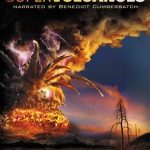
KS2/3 on 'Supervolcanoes.'
The award-winning Supervolcanoes looks back at rare classes of eruptions that have marshaled the energy that lurks, like a sleeping dragon, beneath the surface of planet Earth. The program moves beyond Earth to explore the impact of giant volcanic eruptions around our solar system.
Audiences will fly down to Neptune’s frigid moon Triton, and onto the ultimate volcanic world: Jupiter’s moon Io. On a visit to a legendary North American hot spot, Yellowstone National Park, the film asks: can a supervolcano erupt in our time?
Narrated by Benedict Cumberbatch.
Explore some of our Space Dome themes
Rates
Morning visit: £480 + VAT, for up to three sessions.
Full-day visit: £580 + VAT, for up to five sessions.
Travel or hotel supplements may apply depending on the location and event requirements. Contact us to check availability and request a quote.
Bookings
Contact us for further information and bookings on 020 35766463, send us an email to info@sciencedome.co.uk, or use the contact form below. We will get in touch after we receive your request.
Popular Questions
Got a question? We are here to help.
How far can you travel?
We cover the UK and can consider requests from Ireland. Travel or hotel supplements may apply depending on the location and event requirements. Contact us for a quote.
What's the dome size?
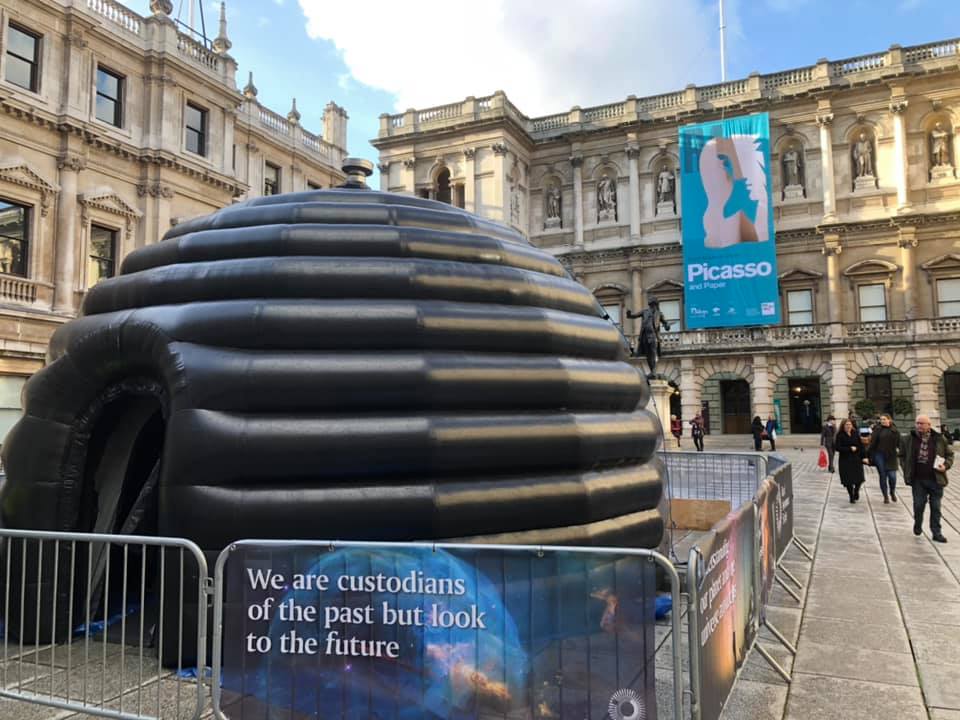
The Science Dome operates eleven mobile digital domes. The dimensions of these domes go from 5-8 meters diameter and 3-5 meters height. Being able to provide different sizes and designs to fit all school and village halls.
For the “wow” factor of a large immersive display environment to entertain large numbers of viewers at a show (or other such venue) our immersive 8m diameter domes would be the ideal match. Being 5.2 metres high, this dome offers a large feature in any show.
How many people can fit in the dome?
Our domes provide different sizes and designs to cater to your needs. Their capacity rank from 25-50 adults till 35-60 primary children in a session.
Get in touch, we will give you a precise feedback according to the type of audience or students’ age to help with the organisation.
Can we have more than one topic on the day?
Of course you can.
Get in touch and we will help you organise the sessions.
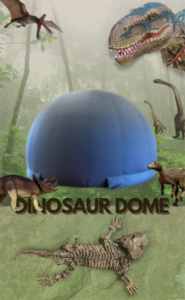
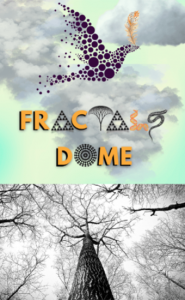
Check out our other domes: Dinosaur Dome and Fractals Dome to explore deeper all the different topics we can cover.
How much does it cost to hire your service?
For schools: Morning visits are £480 + VAT for up to three sessions. Full-day visits are £580 + VAT for up to five sessions. Travel or hotel supplements may apply depending on the location and event requirements.
For youth clubs, Scout groups and adult groups: Prices start from £175 per one-hour session. Contact us for a quote.
Let’s Get Curious About Space
Why is space completely silent?
Is it outer space really a vacuum?
Why do we see a blue sky on Earth but looks black in space?
The molecules present on Earth’s atmosphere scatter light from the sun off in all directions, including towards our eyes, resulting in the blue sky we see on the daytime. However, at night, when that part of Earth faces away from the Sun, space looks black because there is no nearby bright source of light, like the Sun, to be scattered. Now, in the absence of matter like in the outer space, with very few particles, there’s nothing between stars and planets to scatter light to our eyes. That’s why, from the moon, which has no atmosphere, the sky looks black day and night.
Learn more about this at https://starchild.gsfc.nasa.gov/docs/StarChild/questions/
Why is it that there is so little breathable oxygen in space?
How are galaxies formed?
In the early universe, there were no galaxies. Today, there are many billions. Astronomers use the fundamental laws of physics to deduce the basic story of galaxy formation. Galaxies form out of immense clouds of gas that collapse and rotate. As they evolve, stars form within them. Entire galaxies can collide, changing their appearance. Looking deep into space, we see galaxies at earlier stages in their lives, and learn more about their evolution.
How old is the sun?
The explosive temper of the Sun...
Will the sun die?
Eventually, the fuel of the sun, hydrogen, will run out. When this happens, the sun will begin to die. After the hydrogen runs out, there will be a period of 2-3 billion years whereby the sun will go through the phases of star death. Once the hydrogen runs out, our yellow dwarf star will begin to swell. It will swell to a size that will cause it to swallow Mercury, Venus, and Earth. It may even grow to overtake more of the planets. When the sun increases in size it will become a “red giant.” After this, it will lose many of its outer layers and eventually shrink to become a “white dwarf.” White dwarf stars are still very hot, but not nearly as hot as the sun is now. Finally, our star will fade out and become a “black dwarf,” where very little is left of its original form. Black dwarf stars are not hot and don’t put off any energy.
Read more about it on https://askanearthspacescientist.asu.edu/top-question/sun-dying
Is it true that one day on Venus is longer than one year on Earth?
Why is Mercury less hotter than Venus if it is the closest to the sun?
Venus is hotter than Mercury because it has a much thicker atmosphere. Mercury is closer to the Sun but it has a very thin atmosphere and all the heat trapped goes out in space, while Venus with its much thicker atmosphere holds all the heat it gets.
Read more about it on https://www.vedantu.com/question-answer/which-is-the-hottest-planet-of-the-solar-system
There are more trees on Earth than there are stars in the Milky Way.
Differences between comets, asteroids, meteoroids, meteors and meteorites.
Many people get confused about comets, asteroids, meteoroids and meteors. We are going to explain them all here so that we can avoid getting lost in space!
Comets
Comets are leftovers from the dawn of our solar system around 4.6 billion years ago, and consist mostly of ice coated with dark organic material. That’s why they are called cosmic snowballs. They are made of frozen gases, rock, and dust and they orbit the Sun. They have been referred to as “dirty snowballs.” When frozen, they are the size of a small town. When a comet’s orbit brings it close to the Sun, it heats up and spews dust and gases into a giant glowing head larger than most planets. The dust and gases form a tail that stretches away from the Sun for millions of miles. There are likely billions of comets orbiting our Sun in the Kuiper Belt and even more distant Oort Cloud.
The current number of known comets is: 3,856
Comets may yield important clues about the formation of our solar system. Comets may have brought water and organic compounds, the building blocks of life, to the early Earth and other parts of the solar system.
Asteroids
Asteroids, sometimes called minor planets, are rocky, airless remnants left over from the early formation of our solar system about 4.6 billion years ago. Their sizes range from 1 meter to hundreds of kilometres.
The majority of known asteroids orbit within the asteroid belt between Mars and Jupiter (the main asteroid belt), others share a planet’s orbit around the Sun. It is currently believed that at least 5,000 asteroids cross the Earth’s orbit, some coming very close (Near-Earth Asteroids). Large asteroids and comets hit the Earth only once every 100 million years or so, not something that happens very often!
Asteroids usually revolve around the Sun in elliptical orbits, but sometimes they can rotate quite erratically, tumbling as they go. More than 150 asteroids are known to have a small companion moon (some have two moons). There are also binary (double) asteroids, in which two rocky bodies of roughly equal size orbit each other, as well as triple asteroid systems.
The current known asteroid count is: 1,266,738.
Meteoroids, meteors and meteorites
Meteoroids are very small asteroids, with sizes between microns to 1 meter.
When meteoroids enter Earth’s atmosphere (or that of another planet, like Mars) at high speed and burn up, the fireballs or “shooting stars” are called meteors.
When a meteoroid survives a trip through the atmosphere and hits the ground, it’s called a meteorite.
Scientists estimate that about 48.5 tons of meteoric material falls on the Earth each day. Almost all the material is vaporized in Earth’s atmosphere, leaving a bright trail fondly called “shooting stars. “Several meteors per hour can usually be seen on any given night. When there are lots more meteors, you’re watching a meteor shower.
Learn more at https://solarsystem.nasa.gov/asteroids-comets-and-meteors/comets/overview
Why all the planets orbit the Sun in the same direction and how our Solar System was formed…
All eight planets of the Solar System follow an anti-clockwise path around the Sun. Our solar system formed about 4.5 billion years ago from the collapse of a huge cloud of gas and dust. As it collapsed, it formed a solar nebula – a spinning, swirling disk of material. Collisions between dust and friction within the gas would drag material into the same motions as the majority of the gas and dust. At the centre, gravity pulled more and more material in. Eventually, the pressure in the core was so great that hydrogen atoms began to combine and form helium, releasing a tremendous amount of energy. With that, our Sun was born, and it eventually amassed more than 99% of the available matter.
Matter farther out in the disk was also clumping together. These clumps smashed into one another, forming larger and larger objects. Some of them grew big enough for their gravity to shape them into spheres, becoming planets, dwarf planets, and large moons. In other cases, planets did not form: the asteroid belt is made of bits and pieces of the early solar system that could never quite come together into a planet. Other smaller leftover pieces became asteroids, comets, meteoroids, and small, irregular moons.
The general revolution of the disc would transfer to the rotating planets and to the Sun itself.
Most of the angular momentum of the Solar System is in the outer planets, both in rotation and orbital motion.
The Sun itself rotates very slowly, about once a month, while Jupiter and Saturn rotate once every ten hours.
More about this at https://solarsystem.nasa.gov/solar-system/our-solar-system
Explore Our Dome Themes
We Transform Learning Science Into Immersive Journeys
Our different dome themes provide a wide range of topics and subjects for our customers to choose among. Contact us for a chat and advice, we will guide you through the best options according to your type of event. Otherwise, please feel free to explore our domes and if you see anything in particular that you would like to have for your event, just let us know.
Hundreds of customers all around the UK enjoy our services

Interested in our services?
Copyright © All Rights Reserved.